Well, after months of waiting, the stars are right once again and it's time for Portland to get a massive dose of cosmic horror. As I waited on line for my wristband, I started looking over the schedule of events and realized I was not going to see everything I wanted. That path would only lead to madness and I have to be at work on Monday.
First up is a special screening of The Stone Tape, a 1972 BBC production written by Nigel Kneale (writer of the Quartermass films). The festival was given permission to screen this film from both the BBC and the estate of Mr. Kneale, and the odds of ever seeing this again was rather slim, so that presentation was a priority.
It's a slow burn and I could hear some members of the audience getting restless during the screening. But I enjoyed it, despite the dated video effects and poor video quality (the audience was warned the copy looked like a poor bootleg DVD). And it's a nice look at how, as science peels away the mysteries of the universe, we might not be able to deal with the answers we discover.
The ending is a bit weak, but it is engaging, well acted and quite creepy at times. It screens again this afternoon at the fest.
I ended the night with a 35mm screwing of John Carpenter's Prince of Darkness and it was great. The budget shows only at a few points and while a few of the characters are a bit underwritten or overplayed at times, this film is atmospheric and creepy as hell. Great locations, nice use of shadows and, as expected, a terrific score made this a big screen treat. Plays again Sunday afternoon.
Well, got to make my way back to The Hollywood, with a quick detour to Things From Another World (it's Free Comic Day, so show your brick and mortar comic shop some love and financial support). Today, it's the Cabal cut of Nightbreed, some dark radio adventure, then a maddening choice. Oh, the horrors!!!
Saturday, May 4, 2013


Saturday, April 27, 2013
Final Destination 3 (2006)

As Final Destination
2 opened on January of 2003, talks were underway for bringing the franchise
to a close with a final film.
James Wong returned as director and, with writing partner Glen Morgan,
sought to re-infuse the franchise with the atmosphere of dread and paranoia from
the original film. It’s evident
with the opening credits of Final
Destination 3, as the audience is treated to a CGI tour of a creepy
carnival that sets the stage for the impending disaster.
But David Ellis’ work on the second film affected this
production, as the gore and nudity is amped up beyond the previous entries in
the series. It’s unclear whether
this was Wong’s doing, or a demand from the studio. Regardless of the source, the increased exploitation moments
undercut any attempts to return the franchise to its atmosphere-drenched
origins.
While this film was intended as the final entry in the
franchise, the script doesn’t deviate from the basic plot established by the
earlier entries. In this film,
high school senior Wendy (Mary Elizabeth Winstead) is attending a graduation
party at a local carnival. As she
boards the Devil’s Flight rollercoaster, Wendy experiences a vivid premonition
of the car derailing, killing everyone on board.
Snapping out of her vision, her attempt to stop the car from
leaving the boarding zone, resulting in the attendants releasing the restraints
on her section of the cab to escort her out. Several other students, all stereotypes from an assortment
of previous high school movies, to get off as well. But Wendy’s best friend Carrie and her boyfriend Jason are
in a different section of the cab and depart on the ride, which derails as
Wendy predicted.

Crappy CGI, here we come!
As you might guess, freak accidents start to claim the
survivors. Wendy finds out about
the survivor of Flight 180 through Carrie’s boyfriend Kevin (Ryan Merriman) and
starts searching the Internet for more information. Along the way, she discovers the photos she took at the park
holds clues to the fates awaiting each survivor.
Even after the opening credits, one can sense Wong’s attempt
at more detailed character development and atmosphere than action. But his effort doesn’t pay off, as
these scenes feel incomplete. A
perfect example is when, before boarding the Devil’s Flight, Carrie tells Wendy
she plans to end her relationship with Kevin in a few months. Then after the accident, Kevin confides
in Wendy that he’d plan to propose to Carrie at some point after
graduation. It’s a very human
moment, as a person learns secrets that change how she views a person and their
relationship, yet this plot point is just dropped. Sure, Wendy keeps Carrie’s secret, but the script delivers
no payoff to Wendy’s, and the audience’s, discovery.
However, Wong does develop Wendy’s feelings of paranoia
concerning foes both seen and unseen well, playing off moments from the
original film. Wendy keeps hearing
one song before another accident occurs, a wind that seems to have no point of
origin keeps occurring around her.
Windtead’s performance is very good, conveying the sense of paranoia
experienced by the main character that was missing from the second film.
But Final Destination
3 fails on several counts.
First, the CGI in the opening disaster is unrealistic. Wong allows characters to defy the
basic laws of physics to introduce a “cool” shot, fracturing the audience’s
suspension of disbelief and making the sequence look more like a Looney Tunes
Cartoon than a horror film.

What do you mean, I'm defying the laws of physics? I never studied law.
The film also includes a prolonged nude sequence, as two female
survivors visit a tanning salon, which ends up being the site of their
demise. This bit might be
forgivable, but one can’t suspect Wong is criticizing his audience with the
inclusion of Freddie (Sam Easton), a previous graduate who is trying to score
footage of topless women at the park during the opening act. He follows the two women, actually
stereotypical valley girls, onto the Devil’s Flight, hoping to convince them to
flash him, and his camera, during the ride. This obnoxious character (well played by Easton) seems a
rather shallow attempt by Wong to shame horror fans looking for more skin in
the franchise. And once the girls
disrobe in the tanning salon, the most prolonged nude sequence in the
franchise, it appears Wong is rewarding the Freddie’s in horror fandom for
their persistence. At least until
the unlucky pair are set ablaze in the tanning booths, causing one to wonder
whether Wong wants to punish the fanboys for demanding such a display, or the
women who cater to such demands.

Wait, fanboy vengeance is the only reason I'm nude in this shot? Where's my agent?!?!
Sexual politics aside, Freddie also delivers a fatal blow to
the script in the opening disaster.
But, to get into that, I will tread into MAJOR SPOILER TERRITORY for the
next three paragraphs. You have been
warned.
During Wendy’s premonition, the audience sees every detail
of the accident, including the events that set the accident in motion. We get a scene where the brake lines on
the car start leaking, as an attendant forces a restraining device into place
on one of the riders. But, the
ride might not have ended in a derailment had Freddie not been aboard.
Stalking the two valley girls, Freddie boards the Devil’s
Flight behind them, hiding his video camera from the attendants. As the car goes into a series of loops,
he revels his camera and shouts for the girls to, “Show me your titties!” As before, they are repulsed by his
actions and one knocks the camera out of his hand. Falling onto the tracks in front of the car, the camera
causes the brake line to rupture, leading to the eventual derailment.
The problem is, once Wendy comes out of her premonition,
snaps out of it, Freddie follows the two valley girls off the ride, taking his
camera with him. With Freddie off
the ride, his camera will not be knocked loose (and, after all, the girl who
knocks it out of his hand is off the ride as well), inferring the accident
would not happen without this final trigger. It’s a staggering moment of sloppy writing and, as it
appears early in the script, makes the rest of the movie suspect for any audience
member looking for more than blood and boobs.

So, we are in the sequel, right?
Another problem error is the script ignores the survivors
from the second film. While the
events surrounding Flight 180 are referenced, along with the accident from the
second movie, it seems strange the only people who thwarted Death are never
mentioned. Though the survivors
might not fit into Wong’s original idea for the series, that one can not cheat
Death in the end, a brief mention of their deaths, as the death of Alex is
referenced in Part 2, would have cleared up this plot hole.
Despite these flaws, the kills are pretty good and the build
up to most of the deaths are more Rube Goldberg-est than the second film, and
thus more suspenseful. And while
the ending seems rather lackluster for the conclusion of a series, it works
pretty well to sum up Wong and Morgan’s ultimate statement, that Death will
never be cheated out of its prize.
But as long as writers can concoct bizarre ways for people
to die, you know the Final Destination franchise will continue. So rev up your engines as the series
takes on 3D and tries to blow you out of your theater seat.

Well, at least I have The Thing prequel to look forward to....
Monday, April 15, 2013
Warm Bodies (2013)

Zombie fans needn’t shun Warm Bodies for fear of the sparkling undead infecting the
genre. Though the film is more
romantic comedy than horror film, and not the cross over film some people
proclaim it to be, Warm Bodies is a
great date film to share with non-horror fan partners. The movie is quite charming for the
most part, and not the travesty suggested by the trailers.
The film opens with R (Nicholas Hoult) shambling about with
his fellow zombies in an airport he considers home. Through his internal monolog, we find that R has fleeting memories
of being alive, though he is no longer able to act human. He tries to have conversations with
fellow zombie M (Rob Corddry), but the best they can manage is a series of
grunts, unless they are hungry.
R also fears his ultimate fate is to become a “Bony,”
zombies that have ripped off their skin and cast away the last vestige of their
humanity. Though R admits he will
eat the living, he feels bad about doing so, unlike the Bonies.

Let the I Am Legend jokes commence!
Still, the hunger for flesh is a powerful motivator, and R
joins M and a few other zombies as the group leaves the airport to forage for
food. Around the same time, a
group of humans leave their walled city in search of medical supplies. The two groups meet and during the
battle, R and Julie (Teresa Palmer) lock eyes. Julie decides not to fill R’s skull with bullets, and R
decides not to eat her. But he has
no qualms against eating the brains of Perry (Dave Franco), Julie’s boyfriend.
Through his internal monolog, R explains that eating Perry’s
brain will keep his corpse from becoming a zombie, a fate he wouldn’t wish upon
anyone. But R also gets to
experience a partial reconnection to humanity by reliving victim’s
memories. And this makes R fall in
love with Julie.
Disguising Julie as a newly reanimated corpse, R takes her
back to the airport, where he’s decorated a plane with things that remind him
of his humanity. This includes a
pile of vinyl records, allowing the movie to deliver a few musical montages
while he rediscovers how to talk and becomes more human than zombie.

All it took was owning an airplane and a decent collection of LPs to score!
Julie is curious about R’s unzombie-like behavior, but that
doesn’t keep her from attempting to rejoin her human community. During her escape, she is surrounded by
group of zombies, including M. But
once R steps up to protect her, the zombie horde loses interest in Julie as a
food source and let the couple leave the airport.
As the two get closer to the walled city, Julie abandons R, who
heads back to the airport. Before
he arrives, R meets up with M and the other zombies that let him and Julie
leave. In some way, R’s feelings
of love towards Julie infected them as well and reawakened their humanity. Seen as a threat to the zombie
hierarchy, the Bonies cast the group out and plan to kill Julie and R.
Accessing Perry’s memories, R sneaks into the human compound
to warn Julie of the upcoming attack, setting up a conflict between the Bonies,
the evolving zombies and the remaining humans, led by Julie’s father, Grigio
(John Malkovich).
Yes, it’s a zombified version of Shakespeare’s Romeo and Juliet, complete with the balcony
scene. And as annoying that idea might
seem, screenwriter/director Jonathan Levin uses only the basic plot, with
enough deviations to keep things interesting. It’s a refreshing approach when one considers the multiple monster/classic
literature rewrites flooding bookstores in recent years. And while it’s not as original as West Side Story, it works as a charming
and inoffensive update much like 10
Things I Hate About You.

I feel pretty, oh so pretty.... Wait, wrong movie.
It’s unfortunate the familiarity of the tale appears to have
prompted Levin to forgo any real character development. Thanks to his internal monolog, R is
the most developed character in the movie. While M gets a few nice moments, the script never divulges
whether he (or the other zombies) has the same intellectual capacity as R. Malkovich’s Grigio is underdeveloped
and underused in the film, as if the actor’s presence is little more than a
marketing ploy.
But the most glaring problem with the script concerns
Julie. Levin never gives her
enough time away from R to understand how she could fall in love with a walking
corpse, other than it’s dictated by the story.. To be fair, Hoult is the prettiest zombie ever to grace the
screen, and he does stop smelling like a rotting corpse as he becomes more
human. But while one could
understand Julie’s curiosity over a zombie not wanting to eat her, it’s another
thing to fall in love with creature that ate her boyfriend’s brains.
As for the effects, zombie fans shouldn’t expect any gore or
gut munching. Remember, this film
is a romantic comedy at its core and a scene with R covered in the blood and
flesh of Perry would make the thought of Julie falling in love with him an
insurmountable task for the audience.
Levin does get the point across during the film’s only zombie attack
against humans, but the moment is shot so we know what R is doing without
wallowing in the gruesome details.

Yea, I think this gets the point across that R is looking for a quick bite.
As for the Bonies, the CGI creatures look awful. I suspect the reason for not using
actors in full body makeup is to keep the film’s creepiest zombies looking
rather cartoonish, thus ensuring a PG-13 rating. But this failing is easy to forgive once the zombie horde
let by M shows off their “heart lights.”
If you’ve seen the trailer, you no doubt remember this moment, which is
not only pointless to the story, but insulting to the audience as well. The script and the actors do a fine job
conveying the idea that R’s love for Julie is awaking the humanity in other
zombies as well. But Levin decided
the audience is too dense, or stupid, to understand this and decided to film a
roadmap in pretty neon red, rather than assume viewers were smart enough to
follow his story to this point.
Despite it’s flaws, Warm
Bodies is a fun evening’s entertainment. Hoult’s performance is quite good, the script moves at a
nice pace and delivers several good laughs (the bit where Julie and her friend
try to make R look human has the best use of Oh, Pretty Woman in a soundtrack ever). The script contains a few nice satirical moments and zombie
fans will love the nod to Fulci, as he seldom gets any attention in modern
zombie films. And, I must admit,
it was nice to see a movie end without any suggestion of an upcoming
sequel. It doesn’t mean one won’t
be made, but the film closes with a welcomed certainty missing in most recent
genre films.

Wait, you mean Romero isn't the only director of zombie films?
I’m not suggesting zombie fans rush out to see Warm Bodies, or pick it up as a blind
buy when it hits home video. Just keep
it in mind if your evening plans include a partner that is not into the genre. It is not a gateway film, so put aside
all pretenses of digging out The Living
Dead at Manchester Morgue afterwards.
Just settle back and be grateful for a film that you both can watch, and
enjoy, without feeling the nausea you would experience from another Twilight knockoff.
Tuesday, April 9, 2013
Final Destination 2 (2003)

It surprising that three years passed before a sequel
to Final Destination hit the
screens, as the film earned over $55 million in the US box office. New Line Cinema contacted screenwriter
Jeffrey Reddick (who wrote the original story as a spec script for The X-Files) for ideas on where to take
the sequel. But with most of the
original crew unavailable, stuntman turned director David R. Ellis (Cellular, Snakes on a Plane) was hired to shoot the sequel, from a script co-written by the
team of J. Mackye Gruber and Eric Bress.
The film opens as Kimberly (A. J. Cook) and her friends are
preparing to leave for Daytona Beach for spring break. While waiting to merge on the freeway,
Kimberly has a premonition of a catastrophic traffic accident. As with Alex in the first film, she
begins to see events that will take place before the accident and blocks the
off ramp to keep those behind her car from getting involved in the wreck. Though she manages to keep the people
behind her vehicle alive, Kimberly’s friends aren’t so lucky and die as a large
truck smashes through her car.

This won't end well.
As the survivors are questioned at the local police station,
one mentions the events on Flight 180, which happened exactly one year
ago. Dismissing the coincidental
timing, the survivors consider themselves lucky for avoiding the disaster, at
least until one of them dies in a freakish accident.
Convinced Death is coming for them as It did for the
passengers of Flight 180, Kimberly to seek help from Clear Rivers (Ali Larter),
the only living Flight 180 survivor, who has committed herself to a padded cell
in a psychiatric ward. Clear
refuses to leave the safety of her padded cell, but as the death toll rises,
she joins Kimberly in an attempt to break Death’s new cycle and, perhaps,
taking herself off the list as well.
After several more freak accidents, the group discovers the
course of their lives were altered by survivors of Flight 180 and Death is now
cleaning up the mess created by Alex’s vision. They’re only hope is to figure out the mysterious
mortician’s (Tony Todd) vague statement about new life, which was not to be,
nullifying Death’s new design.

So I guess I'm in the sequel, right?
Though the script contains a few nice character moments,
these are quite brief. Unlike the
opening minutes in James Wong’s film, Kimberly barely interacts with her father. Most of the other characters are
various stereotypes, introduced only to keep the story moving, though this
should be obvious when Kimberly and her girlfriend pick up the guys they are
traveling with. These two stoners
are so out of place, compared to the girls, that it is obvious their inclusion
is only so the scriptwriters can add in a gratuitous nude scene.
It’s not to say the script doesn’t have has a few nice character
moments, but the film is more intent on ramping up the gore and mayhem, and
Ellis delivers on that count. The
opening accident is the best in the series, a jaw-dropping scene of vehicular
carnage that might be the best car wreck ever staged for a movie. And the ensuing death scenes are much
more dramatic than the preceding film, with bodies being flattened, dismembered
and impaled at a stunning pace. And
the effects, a combination of practical effects and CGI, still look sharp 10
years later.

Nope, I don't think a few stitches will help....
But the franchise starts tripping on its internal logic with
this entry. And, just to let you
know, I’ll be spoiling the ending to both this film and the previous one, so consider
a SPOILER ALERT in effect for the next four paragraphs.
The mortician tells the group that a new life, one that
occurs because Death’s design was interrupted, might save the remaining
survivors. At first, Kimberly has
visions suggesting a pregnant woman holds the key to their salvation. But she soon discovers that the woman
and her unborn child would have survived the initial accident without her
intervention. Recalling other
visions, Kimberly believes her death, and resurrection, will end the
carnage. But this plot twist
nullifies the ending of the original film, as Alex dies saving Clear, only to
be revived off camera by the FBI agents.
It could be argued that it wasn’t Alex’s turn to die (an
idea that resurfaces later in the series), but the mortician never mentions
that the new life has to occur at any particular place in Death’s new
plan. And the script offers no
explanation for this discrepancy, as if the screenwriters didn’t pay close
enough attention to the previous entry, or just hoped the audience would forget
about that little point.
The link between this batch of survivors and the survivors
of Flight 180 also seems a bit stretched.
Not that their back stories wouldn’t work, but it’s never explained why
Death waited a full year to take them out at one time, rather than kill them in
separate, smaller accidents. Not
only are the odds of everyone being in the same spot at the right time are
pretty astronomical, but waiting so long before killing them would further
disrupt Death’s master plan. This
new group is targeted because their interactions with the survivors of Flight
180 kept them alive, so one can only suspect how many other people’s fates were
changed during past twelve months.
Exploring this wrinkle in the film’s final moments would
make for a perfect lead into the next sequel, but the filmmakers settle for a
splatstick moment that falls flat.
While the scene ties up a loose end from earlier in the film, the humor
feels out of place and the buildup to the death, placing the final survivors in
the right place at the right time, stretches believability to the breaking
point.
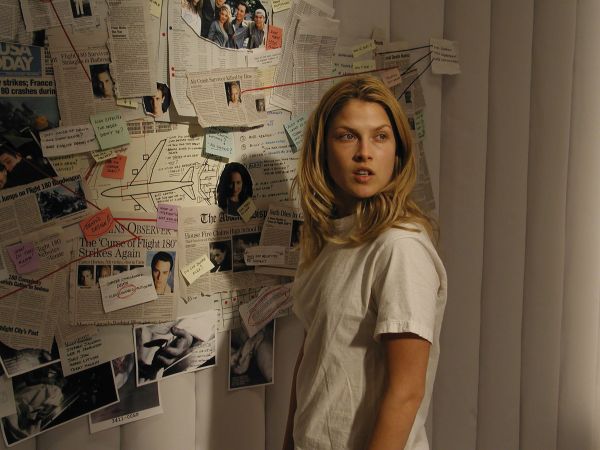
Me, crazy? What makes you think that?
Despite these quibbles, Final
Destination 2 is my choice for the best entry in the series. The opening disaster is amazing, the
deaths come quick and Ellis is unafraid to splash blood across the screen. And the action comes at such a pace
that it’s easy to ignore the script’s shortcomings.
David Wong returns to the director’s chair in Final Destination 3, attempting to
recapture the feelings of paranoia and tension he developed in the
original. But he also tries to
match the amount of mayhem, blood and boobs Ellis delivered, and the mix
doesn’t quite work. And rather
than dealing with a few minor flaws, the script delivers a few near fatal flaws
in the opening disaster. So strap
in, keep your hands in the car at all times and get ready for rather dubious
twists and turns.
Saturday, April 6, 2013
Evil Dead (2013)
Sam Raimi’s The Evil
Dead is one of the few modern horror classics that could use a decent
remake. As much as fans (like
myself) love the film, as much as Raimi’s camera work continues to amaze
audiences, the movie is pretty flawed and ripe for a reinterpretation.
But Evil Dead is
not that movie.
The film starts out with a prolog, as a man is coached on by
a group of hillbillies (who look like rejects from another The Hills Have Eyes film) into burning his Deadite possessed
daughter alive in order to free her soul.
The credits roll and we are introduced to a group of people arriving at
an isolated cabin to help Mia (Jane Levy) kick her drug habit, The group includes Mia’s brother, David (Shiloh Fernandez),
his girlfriend Natalie (Elizabeth Blackmore) and two of Mia’s friends. Olivia (Jessica Lucas) is an RN,
planning to provide medical support to Mia, and Eric (Lou Taylor Pucci), a high
school science teacher and old friend of David as well.
Events start going sour once the group discovers the cabin’s
fruit cellar is full of dead cats and a burned post. At this point, director Fede Alvarez decides the audience is
too stupid to figure out this is the spot where the young woman was burned and
inserts a needless flashback, even though the scene happened less than a half
hour earlier.
The group finds the Book of the Dead and Eric gets to play
the idiot who opens and reads from it, despite the warnings written across its
pages. Mia decides something
creepy is happening and drives away from the cabin, only to meet up with a
rapey patch of thorny vines and is impregnated by the force from the
woods. The others explain away her story, and her wounds, as the
self-inflicted delusions of an addict experiencing DTs. This gives the rainstorm time to flood the
only road to civilization, trapping them in the cabin and allowing the unseen
force try and devour their souls in order to unleash itself upon the rest of
humanity. And, as promised in the
trailer, lots of gory mayhem ensues.
The stupidity of this group, and the script, is almost
forgivable in the beginning. Mia
dumps her drugs down a well, in a ceremony that will ruin the water supply for
everyone, yet no one seems concerned.
Olivia is convinced she can give the same care for Mia as a rehab center,
despite being in the middle of the woods, isolated from any emergency medical
facilities. And one can forgive a
science teacher for reading from the book, without suspecting that the demons
written about would come to life.
And the script never explains why the hillbillies would leave such a
dangerous book in someone’s cabin for others to find, or how the cabin has
electricity without power lines running to it.
But these horror cliches are as forgivable, to a point, as a remake’s nods to the original material. But unlike the best remakes (such as1988’s The Blob), Evil Dead goes nowhere new with those moments. The
scenes exist only to pander to fans of the original, which might have worked had the filmmakers not pulled moments from the two sequels as well as if the scriptwriters (Alvarez and Diablo Cody)
want to include everything that made the series great.
Warning, the next two paragraphs contain some SPOILERS.
It’s a bad idea executed in a horrible fashion. The possessed hand sequence would work
in any film not titled Evil Dead,
but Bruce Campbell’s amazing battle with his own limb in the original sequel makes
the scene fall flat. The fruit
cellar floods, recalling the Pit Bitch moment in Army of Darkness, for no reason other than to include that iconic
scene. And once the sole survivor
shoves their bloody stump into a chainsaw handle, it’s obvious the filmmakers
are simply delivering more of the same, while trying to act fresh for
newcomers. Such a strategy never works, as the fans will be disappointed in the
over wrought winks and nods, while newer audience members won’t get the homage.
Yet the filmmakers decide this wasn't enough and crib bits off
other horror films, in what feels like a desperate attempt to appeal to the fans. Mia becomes the foul
mouthed Regan from The Exorcist in
several scenes, the Deadite possessed bodies move like they are extras from
early 2000’s J-horror films, and the opening shot feels too much like Stanley
Kurbrick’s The Shining to be effective
in showing the cabin’s isolation. This
film is such a paint-by-numbers affair that I was squirming in my seat from
boredom before the film was half over.
On the plus side, the effects look great. Though Alvarez’s claim of not using CGI
seems a bit overblown, as a few of the fire gags look computer enhanced, the
blood and gore is all practical and is amazing work. It’s nice to see a return to old school gore effects, but
fans might wish it served a better film than this one.
By the time the credits finish up, and one of the people involved
with the original gives their seal of approval, I suspect much of the audience
is wondering why anyone would think this remake is so groovy. Rather than trying to be original in any way, Evil Dead is nothing
more than the equivalent of another kitten's photo on the web, asking the
audience to like it without doing anything to earn such admiration other than
appear onscreen.
Sunday, March 31, 2013
Final Destination (2000)
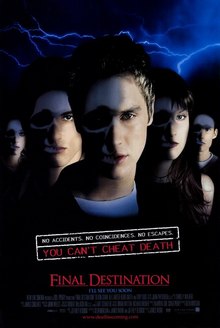
At some point in life, everyone experiences a near death
moment. It might be as mundane as
avoiding a car running a red light, or as dramatic as arriving late for an
appointment to find the building engulfed in flames. Whether you credit God’s intervention or sheer luck, one
cannot deny the sense of relief felt after cheating the Grim Reaper.
The Final Destination
franchise injects a evil twist into this universal experience, the idea that
Death will not tolerate any deviation from the master plan. Though the opportunity to comment on
human mortality is obvious, the series is more interested showing how Death
will rectify the situation, often with a nastier demise than the one avoided. And the series delivers on that promise,
though the thrills are often at the expense of the rules set up earlier in the
franchise. And this includes
2000’s Final Destination, as the
finale breaks the rules set up in the opening acts.

Don't grab the towel!
The film starts as Alex Browning (Devon Sawa) prepares for
his senior trip to France. The
film spends a lot of time (compared to the rest of the franchise) on character
development, as Alex interactions with his caring parents and his best friend,
Tod (Chad Donelly). None of them
notice Alex’s growing unease concerning the flight. He’s not afraid of flying (at least no hint of this phobia
is given in the script), but small events leading up to the plane’s departure
like an airport reader board or a Muzak verion of a John Denver song, disturbs him for some reason.
This feeling of dread culminates once Alex is in his seat,
as he experiences a vivid premonition of the plane exploding during takeoff. Jolting awaken as if from a nightmare,
Alex begins experiencing events from his vision and tries to keep the plane
from leaving the terminal. All he
succeeds in doing is preventing several students, and one teacher, from being
on the plane when it explodes.

Told you so!
Alex’s prediction draws the attention of the FBI and
ostracizes him from the rest of his class, including Tod. The only person who will talk to him is
Clear Waters (Ali Larter), who left the plane because of some unexplained link,
which allowed her to experience the terror Alex experienced after his vision.
Soon, the survivors start dying in unexplained accidents,
while Alex sees cryptic clues predicting each upcoming death. Taking the advice of a local mortician
(Tony Todd), who knows quite a bit about Death’s grand plan, Alex sets out to
save the next victim in an attempt to break this new cycle of death.

I told her not to grab the towel.
The film sets up the template for the franchise, with a
spectacular disaster followed by a series of deaths set in motion by events
that would make Rube Goldberg proud.
And, by the middle of each film, the dwindling survivors work to prevent
their impending demise. But the
film’s pacing set it apart from most of the other films in the franchise. Co-writer/director James Wong delivers
a slow first act, setting up Alex’s sense of isolation and paranoia after the
plane crash. And the slow burn
continues, as we get several scenes with Alex and Clear that are more about
building characters and atmosphere than moving the story to the next death
scene.
The pacing gives the film more weight to this film compared
to others in the series and might be a result of the script’s origin. Written as a potential episode for The X-Files by Jeffery Reddick, the
story was expanded into a feature film by Wong and his co-writing partner Glen
Morgan, with the intent of the production serving as Wong’s directorial debut. The sense of dread and paranoia is a
perfect fit for the television series, and the two FBI agents are scaled back
versions of Scully and Mulder.
But the story’s expansion to a feature film created a few problems. The most glaring visual problem is the
physical presence of Death. As a shadowy figure glimpsed by the victims before
their death, its presence works fine.
However, the final act, which seems extended for a feature film, allows
the physical presence of Death to be onscreen too long. Not only are CG effects rather poor,
even for the time, the figure never interacts with the environment, which
further weakens the story. Previous
incidents imply an unseen hand setting events into motion, yet this spectral
being just swoops about during the climax, trying to look scary without doing
anything threatening.
Another problem involves Tod’s death, instigated after he
slips on a puddle of water from a toilet that picks that moment to spring a
leak. After he dies, the water is
drawn back into the toilet, as if Death is concerned about covering any
evidence of its presence. The
scene is unnecessary, as Death left plenty of other traces that would lead any
competent investigation to conclude the death was accidental.

Tony Todd as the creepy mortician
(SPOILER ALERT. The next three paragraphs will discuss
the film’s final act, so if you haven’t seen the film yet, you’ve been warned.)
But these complaints are minor, as the final act breaks the
rules set up earlier in the movie.
Having failed at every attempt to keep the survivors alive, Alex
realizes he is next and sets out to “death proof” a cabin near Clear’s
house. Yet he suddenly decides
that he would not have changed his seat (as he did during and after his
vision), which makes Clear the next victim. And Death is already busy at Clear’s house, giving new
meaning to the “act of God” insurance clause.
It’s an exciting sequence, but makes no sense. Alex’s suspicion that he wouldn’t have
changed seats isn’t supported by either his vision or the events that followed. One could argue that the attack on Clear
is a ruse to draw Alex out of his safe house, but the script never implies that
Death is using Clear as a bait. Alex
almost drowns during his trek to Clear’s house, which nullifies that
possibility since Death could have taken his life then. Furthermore, the attempt on Clear’s
life is just too intense to be a ruse.
Her death is a distinct possibility at several times and if the victims
need to die in a specific order, such an attack would be a threat to Death’s
design should Clear die.
The film does try to tie everything together at the end, as
a survivor who avoided his second brush with Death is the victim of another
freak accident. But the final
scene is more an attempt to leave open the possibility of a sequel, rather than
close up any plot holes.
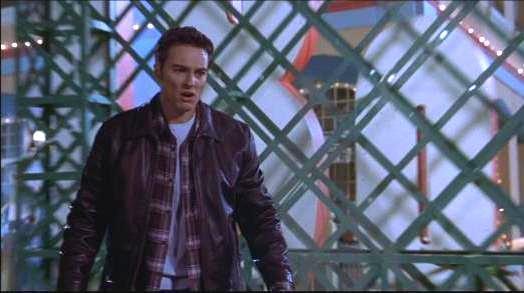
So, think I'll be back for the sequel?
Despite these flaws, Final
Destination is an enjoyable film.
The acting is solid (with only one painfully wooden performance) and the
death scenes are an effective mix of practical and CG effects. Also, several of the characters are
named after genre filmmakers, a nice treat for fans, but one that might seem a
bit presumptuous on the filmmaker’s part.
Naming one of the characters after Val Lewton invites comparisons to his
work, and as fun as Final Destination
is, it’s no Cat People or I Walk with a Zombie.
The franchise is off to a solid start, but a new director
and writer will kick the series into high gear. So buckle your seat belt and steer clear of logging trucks
(rather difficult in the Pacific Northwest) as we take a look a Final Destination 2 next. Beware, more mayhem, less story
and more logic problems on the road ahead!
Tuesday, February 12, 2013
John Dies at the End (2011)
Okay, time for some full disclosure stuff. I planned to have this review posted a
bit earlier, as I went to the Portland premiere of John Dies at the End on Friday night. But, a long week at work, combined with my early shifts and
a couple of pints before entering The Hollywood Theatre, I incurred a series
case of the head nods and dozed off during the final act.
So, you might expect this review to slam the film for being
boring, but that’s not the case. John Dies is fun, innovative and
contained more interesting time travel moments than Looper. And the film
was so engaging, I had to see what I missed, so I returned to The Hollywood on Sunday
afternoon and watched the entire film while awake.
Besides, I couldn’t write a review of a movie I didn’t see
through till the end. That would
be wrong.
The film opens at a Chinese restaurant as David Wong (Chase
Williamson) is telling the story of how he and his friend John (Rob Mayes)
saved the world from an otherworldly invasion to a reporter (Paul
Giamatti). David is using a new
drug called Soy Sauce, which gives a person incredible insight into reality and
time traveling abilities. But some
of the users come back as breeding stock for beings from another dimension, and
David wants to get the story out.
And that’s the plot.
It seems simple, yet director/screenwriter Don Coscarelli weaves
together a tale full of seemingly nonsensical twists and turns that become
clear as the movie progresses. No
stranger to dreamlike movies, Coscarelli’s Phantasm
series has the same hallucinogenic feel as this film. And, like Bubba
Ho-Tep, the audience wants to believe the hero, no matter how much the
surrounding characters, and the ensuing events, point out the fallacy of this
belief.
The acting is very subdued and fits the story. Williamson and Meyes come off like a
couple of losers thrust into an adventure they can’t comprehend, let alone
influence in any way, fitting the feel of the film and it’s overall conclusion. The rest of the cast, including Doug
Jones, Clancy Brown and Glynn Turman, keep a straight face throughout all the
craziness, leading the audience questioning whether the story is just David’s
bad trip. Only Giamatti cuts
loose, as the final resolution for his character’s arc allows for it, and makes
perfect sense for whatever conclusion the audience come to concerning David’s
tale.
But the genius of the film comes from the script (based on
an e-novel by author David Wong), as the audience is given hints that David’s
story is suspect and could be the results of a bad trip. As events unfold, the script is always
fuzzy on whether the events David is relating to the reporter are real or not. And, as with Bubba Ho-Tep, Coscarelli doesn’t try to persuade the audience, but
gives them enough to decide if the characters are true heroes or just seriously
delusional.
As author Wong has written a sequel, This Book is Full of Spiders: Seriously Dude, Don’t Touch It, I
want to believe David’s story, despite any hints that was all a bad trip. It’s all in the hope Coscarelli will to
make a follow up film and allow us to follow David on other world-saving,
possibly hallucinated, adventure. Because following him was much more fun than any financed Hollywood movie I've seen in a while.
Subscribe to:
Posts (Atom)