Wednesday, December 4, 2013

Interview with Jeremy Jantz, Part One

Last night, I posted about the upcoming Salon De Refuse Film Festival at The Academy Theater on Thursday, December 12, at 10 pm.  The festival organizer, Jeremy Jantz, started the festival after being informed his short horror film, Heels, would not be shown during The Art Institute of Portland senior project screening without some editing, as determined by the school.

Back in September of this year, a couple months before The Art Institute demanded cuts in his senior project, I sat down with Jantz to talk about Heels and his desire to make an adult horror film.


The Shadow Over Portland:  I’m talking with Jeremy Jantz, a film student at The Art Institute of Portland.  You’re working on your final project, a horror film called Heels.  Can you tell about it?

Jeremy Jantz:  It’s a short film, about twelve minutes long.  It’s a horror piece based on a short story by Stoker award winning author Lucy Taylor.  Basically, it would fall into the rape/revenge genre, but with a certain amount of twists to it.  And it definitely doesn’t shy away from the nudity or the gore or the subject matter.


TSOP: When we were talking about your film via email, you were saying it was going to be an NC-17 horror film.  What’s the reception from the school to that?

JJ: Well, the instructor, Kyle Aldrich, who initially approved the script and got me started working on it, ironically, he’s trying to sell it to a couple of the other instructors, but then there is a change in faculty.  He’s the head of the department now, so he’s already approved my script.  I’ve already started work on it, they don’t have a whole lot of choice.  At the end of the day, I’m the kind of guy that’s going to make the movie anyway.  It’s my four to five thousand dollars, it’s not theirs.  And, as far as I’m concerned, the worse they can do is not show it in their senior film screening.  If that’s the case, I would rent out The Hollywood Theatre and show it myself anyway.  And they know that.  So, they are in a kind of an awkward position, because if it turns out really good, and they don’t support it, then what do they do?  And the Art Institute, if they want to compete with some of the bigger schools, this isn’t the type of script that would cause a lot of eye blinking in NYU or California.  So, if you want to play with the big boys, you need to be prepared to accept the kind of adult films that they make at big boy schools.  Anybody can make the sort of Tosh 2.0 crap and throw it on YouTube and say this is my senior film.  I really wanted to say, look, we can make adult films.  I’m 37, I’m a bit older than some of the other students there, and this is what I wanted to do.  I’m making the film I wanted to see.  Hopefully, other people will want to see it too.


TSOP:  When you’re talking adult film, are you talking violence, are you talking sexuality, are you talking content or are you talking all three?

JJ:  It’s definitely all three.  The ironic thing is, there’s not any conventional sex scenes in the film, at least not man/woman, man/man or woman/woman.  But there is full frontal nudity on the part of the male lead and the female lead, the female supporting actress gets topless, so basically all three people involved in the movie get fairly naked.  There is gore, there is… I don’t want to give away too much of the end of it, but it definitely goes gory.  I had an effects guy I hired, there were prosthetics that were cast, so you can expect to see that. 

And then, just in tone, it makes a fairly adult statement as far as the way human beings are.  When the story was originally written, the author was trying to make a commentary on how men tend to treat women as victims, and she wanted to say, you know what, sometimes we’re not the victim. 
So, you’re going to see something different, and it’s going to be very violent at the end. 


TSOP:  Let’s talk a little bit about you for a second.  What drew you to the horror genre?

JJ: You know, I’ve been watching horror films and reading horror books since I was little.  I was the child of a single mother and largely babysat by an aunt that was in her late teens.  Not necessarily big on the censoring.  So, on HBO at the time, you could see things like the original Friday the 13th, The Shining, Halloween, Halloween Two…  I actually grew up, four, five, six years old, watching these movies on TV at that age.  So, I guess it just really took root, and it’s been something I’ve been wanting to do ever since.

You don’t see a lot of horror senior films and, ever since the first films I’ve been making, I’ve been pushing it, going for the horror and this is my chance to finally make something I can be proud of. 


TSOP:  Now, you’re talking about going NC-17, which may be understandable for the subject matter.  But if you could film the story as a PG-13 film, would you do that?

JJ:  I would not have in this case, because everything I wrote is true to the original story.  And one of the things I promised Lucy Taylor was that I would be true to her story.  In fact, I used the phrase, “I wasn’t going to Lawnmower Man her,”  because I want her to be just as proud of this too.  The nudity and the violence, it’s what she wrote, and it’s what she intended.  It was published in a collection of stories dedicated to the splatterpunk genre, because the story’s from the early to mid 90s, and splatterpuck was really big back then.  So she wrote it without pulling punches, and to honor her, I have to film it without pulling punches. 


TSOP:  How did you get the rights to film this story?
JJ:  I started out by rereading lots and lots of short stories, looking for something that would strike a chord, something that was filmable.  And from there, I picked Heels, which was my first choice.  She (Taylor) has a way to contact her on her website, so I wrote her a pitch email and said, “Here’s who I am, here’s what I’d like to do.”  She got back to me and said no problem, you have to talk with my agent.  So I wrote her agent an email and within a month, I had the contract signed and I have festival rights for the story.  Not only did I get the rights, but Lucy’s been incredibly supportive.  She blogs about the film, she talks about it on her Facebook page, she likes the updates I put on (the film’s) Facebook page.  So, she’s been a real hands-on participant in bringing this vision to the screen.

TSOP: Do you plan to release your film in festivals around the nation, or around the world?

JJ:  Well, at least as far as Canada.  Canada is on the schedule.  I’m hoping to produce something that I can enter into festivals on an international level and have it be well received.


TSOP:  Who were your inspirations for wanting to be a director?  It doesn’t have to be a genre figure. 

JJ: If I’m going to go classical, I do love (Dario) Argento.  I think he filmed some fantastic stuff and there are some nods to Argento’s style in my film, like excessive blood and garish colors.  And it has a bit of a giallo feel to it.

Lately, I really love Adam Green’s stuff.  I know some people don’t respect the Hatchet series, but I really like it.  I don’t care, I have fun with it.  It can’t all be Kubrick and The Shining, which is a really fantastic film, but there is nothing wrong with just having fun.

And something like that was also guiding me with where I was going (with Heels).  There is definitely an homage to the 80s.  The film is not set in the 80s, but you don’t see any cell phones, you don’t see the cars.  A lot of the art direction and wardrobe choices, I went with an 80s feel.  And I was trying to do that in the same way I think Adam Green was trying to do with Hatchet.  He was saying, look here, those were some fun years, why can’t we just do that?

Ti West is great too, but it’s a different thing.  And I would say, as far as a directing style, it would be more Adam Green.


TSOP:  Any final points you want to mention about Heels? 

JJ:  It’s very practical effects driven, so if you’re the kind of person that wonders why all the stuff is CGI, I’ve got some practical effects for you. 

It’s not going to be a film for everybody, I know that.  But the people that would like it, I think are really going to like it.  There are some crew members I lost along the way, once they read the script.  Their families are going to be there that night, and they were like, “Nope, I can’t do it.”  I had one acting agency that refused to pass my casting call along, I had to cold call Sophia St. James, I had to go to her.  I was in talks with Ron Jeremy’s people for a while.  I couldn’t afford to fly his entourage out here.  So that’s been the journey this film has been, and when you see it, you might have a lot more questions and we can get together and talk about it then.


TSOP: Can you tell my readers a little about Sophia St. James?

JJ: She is an award winning, queer porn star.  She’s on the plus side…  Oh you put me on the spot with the porn star question.  I really needed someone who was sized, willing to do full frontal nudity and was comfortable with that without making it all about the body.  And Sophia St. James really promotes that.  She does burlesque, she does stage shows, a lot of talks and such.  She’s very community minded.  And she’s a horror fan.  She was naming movies at random when she got this role, a couple of normal ones, the 976-EVIL.  Who comes up with that off the top of their head?  It’s a cool movie, but who pops up with that?

TSOP:  One final question.  Favorite horror film?

JJ:  I’m going to go with The Shining.  It’s cliché, but the thing is, it’s one film that so transcended the genre, it really is underrated.  I feel The Exorcist is overrated.  Maybe it’s because I wasn’t raised religiously, but I don’t find it very spooky.  But The Shining is just, wow.  It deserved an Oscar.


Check back at The Shadow Over Portland tomorrow, as Jeremy Jantz talks about The Art Institute of Portland's reaction to Heels, and more about The First Annual Salon De Refuse Film Festival.

Tuesday, December 3, 2013

Film student Jeremy Jantz starts The Salon De Refuse Film Festival after his school demands cuts in his short horror film

Portland area film student Jeremy Jantz was told last month that The Art Institute of Portland would not screen his short horror film, Heels, at the official senior film screening unless he was willing to edit it.  Rather than make any cuts, Jantz responded by started The First Annual Salon De Refuse Film Festival.  The festival lineup includes The Bighead, from director Michael Ling (based on the Edward Lee novel), Brendan Jones' The Test, a tester reel of Survivor Type (based on a story by Stephen King) and Jantz's controversial short.

The Salon De Refuse Film Festival starts at 10 pm on Thursday, December 12, at The Academy Theater in Portland, OR.  Admission is free.

Stay turned to The Shadow Over Portland for more information on the festival as it becomes available, and for a two part interview with Jeremy Jantz concerning Heels and the Salon De Refuse Film Festival!

For more information on the festival, and updates on the films being shown, visit the Heels Facebook page.

Friday, November 29, 2013

Frightfully Funny Black Friday

Okay, the latest horror events in the Northwest are coming, but until then, enjoy this NSFW music video, Zombie Christmas, by Emmy the Great and Tim Wheeler.  It's awesome, and you can pick up the song on iTunes!  Check it out!!


Sunday, November 24, 2013

The Green Slime (1968)


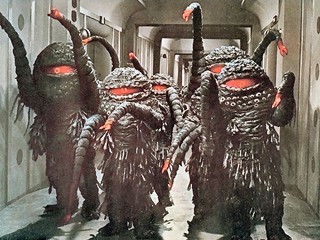
A co-production between MGM and Toei Studios, The Green Slime is the equivalent of a Saturday night Syfy movie.  You’ll never say it’s a good movie and the script has a few problems.  But the film is a great slice of cheesy fun and any quibbles about the script or special effects won’t diminish the joy of watching a group of astronauts battle silly rubber monsters with electrified tentacles.


What more can you want from this movie?

It’s the future and the international space agency discovers a giant asteroid is only 10 hours away from colliding with Earth.  I guess telescope technology has taken a few steps backwards, but hey, they have flying cars!  Looking out into space just wasn't as important as flying cars.  

Only retired Commander Jack Rankin (Robert Horton) is considered able to lead an expedition intent on destroying the space rock.  Of course, his rendezvous point is a space station ran by his ex-partner, Commander Vince Elliott (Richard Jaeckel), who Rankin considers unfit for a command position.  Oh, and Elliott is engaged to Rankin’s former flame, Dr. Lisa Benson (Luciana Paluzzi).  Yep, nothing could go wrong there.

Rankin, Elliott and a team from the station land upon the asteroid and start planting bombs, in scenes that makes one suspect Michael Bay saw this film as a kid.  The station’s scientist tags along, against Rankin’s wishes, and finds puddles of living Green Slime, the first proof of extraterrestrial life in the universe.  Rankin throws a bit of a tantrum when the scientist questions his orders to leave the specimen behind.  To foil any further arguments, Rankin grabs the glass jar containing the Slime and smashes it on the ground.  It shuts the scientist up, but allows a drop of the Slime to hitch a ride back to the space station in the folds of an astronaut’s suit.

The asteroid is destroyed, the rocket manages to survive the blast, and once the crew returns to the station, everyone starts dancing and drinking champagne in celebration.  Okay, I’m not a future astronaut, but one has to wonder why the station takes up precious storage space for crates of champagne. 


Flying cars and space stations loaded with booze!  The future looks awesome!

Of course, every party has a pooper and in this case, it’s that spot of Green Slime, which mutates during the Rankin-ordered triple decontamination of the space suits into a walking, one eyed, tentacle waving messenger of death for the poor technician that wasn’t invited to the party.  Elliott tries to capture the creature alive, but this leads to the death of several crewmen.  Of course, Rankin’s solution is to shoot the creature, which does little to keep the Slime creature from scurrying into the bowels of the station.  But it does leave a trail of Slime creature blood that spawns more of the little monsters.  And, as these creatures feed on any energy source, Rankin’s laser rifle attack has the same effect as offering the Slime creature a Red Bull.

Soon, the station is full of the Slime creatures, Rankin and Elliott quarrel as Rankin orders the destruction of the space station and the growing horde of Slime monsters make it to the exterior of the station, jamming the launch bay doors.  Rankin orders a group of men to battle the critters, allowing Elliott to defy Rankin and leads his men into battle with the monsters. 


Uh, can you direct us to the nearest airlock?

If you’re a fan of B-movies, you know the rest (be warned, there are SPOILERS ahead).  The crew is evacuated, but the remote self-destruct device fails, so SOMEONE stays behind to detonate the station.  SOMEONE goes back to help, SOMEONE dies and the messy love triangle is resolved.  

The script offers no surprise, but that doesn't matter, as the Slime creature attacks come often enough that one can forgive the cliched love triangle and hackney pissing match between Rankin and Elliott.  But the film fails by making Rankin, the film’s hero, a colossal ass.  It’s obvious the script wants the audience to root for Rankin, with his cocksure manner, perfectly coiffed hair and the fact that the sexy Dr. Benson is always looking at him longingly, even as she protests too much about their relationship being over.  And, sure, he might have a point criticizing Elliott for a botched rescue attempt in his past, but the script does nothing to make the character appealing.  

His little tantrum on the asteroid makes him more of a bully and less of a commander.  And while he berates Elliott for the botched attempt to take the creature alive, it’s his actions on the asteroid that allows the Slime to tag along.  And his order for a triple-decontamination of the space suits allows the Slime to mutate into a walking menace.  Finally, his decision to shoot the creature leads to the station’s infestation, making Elliott’s attempt seem the sensible decision.  Sure, it’s all hindsight, but Rankin continually berates Elliott’s previous command decisions without reflecting upon his own missteps,  And, while Rankin is comfortable sending a squad to battle the creatures on the surface of the station, while Elliott leaves the safety of the station to fight alongside his men.  

In fact, the script makes Elliott more heroic than Rankin, who comes off as more of a number cruncher, estimating the best course of action based on the least risk, while Elliott would have your back, no matter the danger.  


Come on, this is what the hero of this picture should be doing, rather than hiding in a command center

And Jenkins little "thumb up" salute to anyone injured or grieving comes off as pretty insensitive.  I suspect the filmmakers were trying to tie into the Apollo missions, showing that Jenkins is made of “the right stuff.”  It might have worked in the late 60's, but it comes off as (for lack of a better term) rather dickish and insensitive.  I hope kids in the audience, with dreams of becoming astronauts, were not inspired by Rankin, as such a role model would provide little hope for the future of successful space exploration.

That’s not to say Horton is a bad lead, but he’s as mishandled by the script as Paluzzi.  Sure, her role as Dr. Benson is to look good and give Rankin a reason to try and rekindle their relationship.  But after playing a lusty SPECTRE assassin in Thunderball, reduced Paluzzi to the damsel in distress is a bit of a let down.  If you cast an actress who gave James Bond a run for his money four years earlier, she needs to be given a bit more to do than scream and wait for the boys to come running.


Sorry fella, you're no Sean Connery

Given the previous paragraphs, one would suspect I didn’t like The Green Slime.  But, as stated at the start of this review, such criticisms can’t dispel the film’s charms.  Sure, you could pick the script to pieces, but the action starts early and seldom lets up, leaving the audience little time to realize how silly the story is.  The battles with the creatures (especially outside the space station) are pretty exciting, if you can accept the limited effects of the time.  And the filmmakers up the ante with some pretty graphic mayhem.  The Slime’s victims look horrific, thanks to some understated makeup and great cinematography.  And a nice bit of editing makes a falling victim look like he squirts blood from his head as he hits the ground.  It’s nothing compared to what you might see on television these days, but it adds to the menace of the monsters and makes them a more convincible threat than one would expect. 


Not exactly what you'd expect to see in a G-rated film, is it?

Whether it was the filmmaker’s intent or not, most B-movie fan’s inner five year old will squeal with delight as the spacemen battle those silly, yet iconic, rubber suited monsters.  And the story moves at a rapid enough pace that you won’t think too hard about the script’s problems until after the closing credits roll.  Invite some friends over, have a few drinks and enjoy the cheesiness!

You can buy The Green Slime through Warner Archives as a DVD On Demand.  Though it has no special features, the picture and sound quality is quite good and this version will do until the film is given a proper release by some other distributor (you listening, Scream Factory?).  

On a final note, I can’t forget to mention the theme song, one of the weirdest to ever grace a monster movie soundtrack.  Take a listen below…


Friday, November 22, 2013

Frightfully Funny Friday offering

So wrong, yet so hypnotic....

I can't stop watching this one......


This music video for Beyond Re-Animator is such a bad idea.  Yet, it achieves the awesome level of Ed Wood movies and Manos.  Just, wow....

Wednesday, November 6, 2013

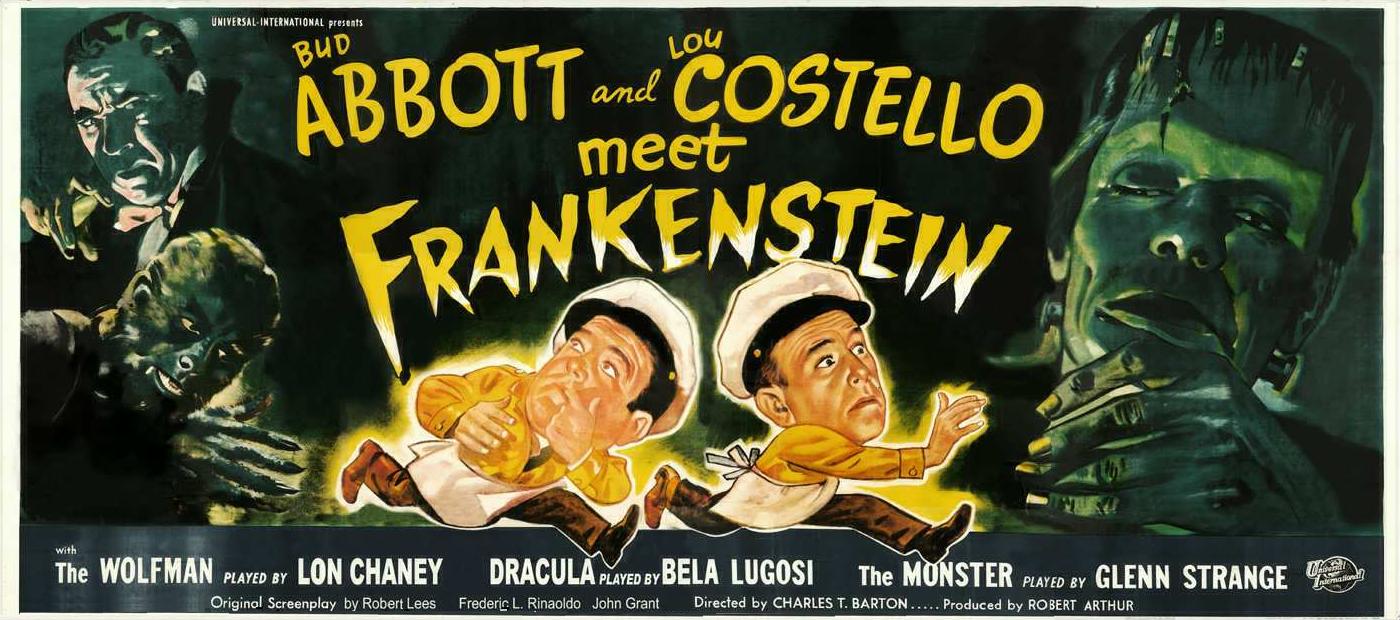
Abbott and Costello Meet Frankenstein (1948)


Most horror fans might consider Ghostbusters the best horror comedy ever filmed.  Though one cannot deny it’s a great movie, I suggest fans check out Abbott and Costello Meet Frankenstein and see if it knocks the modern, effects drenched film from their top slot.

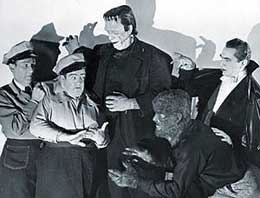
This film features the classic The Universal Monsters, as the comedy duo face not only the Frankenstein’s Monster (Glenn Strange), but also The Wolf Man (Lon Chaney Jr.) and Dracula (Bela Lugosi, in his second, and final, appearance as Dracula).  That’s a classic line up, topped only by The Monster Squad.  And, like most classic comedies, the humor still works.  It might be considered tame and dated compared to modern horror comedies, but the film moves at a brisk pace and contains enough double entendres to keep fans of more adult humor happy.


How can you not love such a line up of classic monsters?


The film opens as Larry Talbot is trying to reach a shipping company in Florida.  Talbot has been on the trail of Dracula, who plans to revive the Frankenstein’s monster for some nefarious reason. Dracula's plot is never explained, but it doesn’t matter.

Talbot has the misfortune of talking to Wilbur (Costello), who works at the shipping company with his friend Chick (Abbott).  Or perhaps frenemy is a better turn, as Chick berates and smacks Wilbur every few minutes.  Anyway, Talbot tries to divert a shipment to McDougal’s House of Horrors, but the full moon rises and he becomes the Wolf Man before persuading Wilbur to prevent the deliver.

Wilbur and Chick deliver the crates containing the coffin (and body) of Dracula and the inanimate body of The Monster during a dark and stormy night (Yea, like you were expect otherwise).  Dracula revives the weakened Monster and the two walk out of the building, leaving Wilbur to try and convince McDougal and the police that the exhibits left on their own accord. 


I SO want a blooper reel for this film!

No one believes Wilbur, so he and Chick are arrested for the theft of McDougal’s exhibits.  The two are bailed out by a woman they assumed to be Wilbur’s girlfriend, Sandra (Lénore Aubert).  But insurance investigator Joan Raymond (Jane Randolph) is the one responsible for getting them out of jail, and plans to charm Wilbur into telling her what happened to the exhibits.

As expected, Sandra is working with Dracula and plans to transplant Wilbur’s brain into The Monster’s body, making it more susceptible to Dracula’s hypnotic power.  In the meantime, Talbot arrives in Florida, but his attempts to find Dracula are thwarted by the full moon.  It all culminates in a monster battle at a spooky castle that happens to be located in a Florida swamp.


The castle looked so big on the outside, yet in every hallway,
there's The Monster!


Yes, the plot is crammed full of troupes from previous Universal horror films and the early slapstick routines are pretty bad.  But one the monsters show up, the film is terrific.  Abbott and Costello’s comedy routines are perfect once the film discards the physical humor for some witty wordplay.  Wilbur’s antics are still wonderful, echoing the upcoming antics of Shaggy and Scooby at their best.  Chick’s disbelief in two beautiful women vying for Wilbur’s affections leads to some great one-liners for the adult members of the audience.  And that doesn’t include Talbot trying to explain how he will become a wolf later that evening, and Wilbur commenting, “You and twenty million other guys.”  It’s not sophisticated, but such comedy moments hit the mark more often than miss.

At the other end of the spectrum, Chaney, Lugosi and Strange all deliver in their roles.  It’s terrific to see Lugosi get the chance to be Dracula once again, and Chaney is as tortured as ever.  Strange only gets to lumber about as The Monster, but his stature is quite imposing and very menacing during the final act.


And Strange even popped Costello a good one in this scene.  
Yep, comedy is hard, and sometimes painful.


Unlike later Abbott and Costello Meet… features, the monsters are treated as serious threats, adding to the film’s charm.  Okay, the Wolf Man is played as a bit of a buffoon as he stalks Wilbur through the woods late in the second act, but it’s a slight lapse made for the sake of the plot.  In every other scene, the monsters are treated as respectable threats to the characters, despite Abbott and Costello’s comedy antics infused into the spooky moments.  The balance works, even though the audience knows the two buffoons will make it to the ending credits, while the monsters will perish (for the moment).  And be sure to keep an ear out, as another Universal Monster makes a guest appearance in the final scene.  It’s a great cameo (dis)appearance.

Despite the dated material, Abbott and Costello Meet Frankenstein is a sad comment on the state of current horror comedies.   Though the film is pretty childish at times, it’s nice to laugh at some wacky antics around scary monsters and settings, rather than a barrage of flatulence jokes.  Like The Ghost and Mr. Chicken, this film is another example that the art of writing good horror comedies has become lost to modern Hollywood.  


Damn right, our movie is better than the entire Scary Movie franchise!

Tuesday, October 29, 2013

Sugar Hill (1974)


In 1968, George Romero changed the cinematic zombie forever.  Night of the Living Dead disassociated the undead from their voodoo roots, making them flesh eating corpses created by an unknown force.  And though a few films maintained the zombie’s traditional origins during the 70s, the release of Dawn of the Dead buried the voodoo element under a cinematic spilling of blood and intestines. 

One of the tradition zombie films released between Night and Dawn was 1974’s Sugar Hill, a successful mix of traditional horror and blacksploitation elements from AIP (following the earlier Blacula and Scream, Blacula, Scream).  But viewers expecting a level of social commentary akin to Romero’s works will be disappointed.  Other than the basic blacksploitation trappings, Sugar Hill is little more than a simple revenge story wrapped in horror trappings.  But the film works thanks to a plot that transcends the racial turmoil of the time, a good cast, some creepy moments and surprisingly good zombie makeup.

The film opens at The Haitian nightclub.  Langston (Larry Don Johnson), the club’s owner, is being pressured to sell out to local gangster Morgan (Robert Quarry).  As Langston is steadfast in his refusal to sell, Morgan’s men beat him to death.


Yea, blink and you'll miss his performance


Langston’s girlfriend, Diana “Sugar” Hill, (Marki Bey), isn’t content to wait for the police to build a case against Morgan and his men.  Summoning voodoo lord of the dead Baron Samedi (Don Pedro Colley), she gains a zombie army and goes on a murderous rampage, dispatching the gang members before moving up to Morgan and his racist girlfriend.

As a blacksploitation film, Sugar Hill contains elements that could offend modern viewers.  Morgan and those around him drop the N-word with a shocking casualness, but one has to remember such attitudes were openly expressed with such language only a few decades ago.  And while Morgan is a surrogate figure for the white establishment that maintained a position of superiority through racial discrimination, the fact that his attitudes don't seem so outdated today is a bit depressing.  Perhaps such views are hidden from the public eye, but a quick tour of the Internet will show just how little some people have changed since the 70s.

But let's get back to the film, and Bey’s changing hairstyle.  Some might consider this a continuity error at first, but her appearance is another bit of political subtext in the film.  When we are first introduced to Sugar, and in all her dealings with “acceptable” (white) society, her hair is a shellacked helmet, designed to help her fit into a culture that would ostracize her.  Yet, once she unleashes her zombie army, the helmet is discarded.  Her Afro becomes a declaration against the white establishment that oppresses her.  It’s not subtle by any means, but quite effective.


Well, if I'm about to be fed to hungry pigs, I imagine this might be
 a more pleasant final image than Anthony Hopkins glaring at me.

But any examination of racial tensions is of secondary importance to the filmmakers.  And were the blacksploitation elements removed from the script, Sugar Hill would still work as a basic revenge flick.  Given the ease in which a modern audience could empathize with Sugar's desire to avenge her love's death, I’m surprised this film continues to be overlooked by many horror fans.  Despite the limitations of the budget, and of visual effects at the time, Sugar Hill is one of the better non-Romero-style zombie movies made and deserves a bigger fan base.

While the cast is fine, Colley’s performance as Baron Somedi is terrific.  While the character is a bit over the top most of the time, but one scene stands out.  The Baron watches one of Morgan’s men threaten a street fruit seller, and the expression of dismay and anger on Somedi's face is amazing.  And it gives credence to the film’s conclusion, as The Baron accepts a lesser payment than expected for his services.  This scene, which could be easy to overlook, solidifies the idea that Somedi's motivations for helping Sugar changed as he witnessed the intolerance practiced by Morgan and his men.


But damn, his less subtle moments are such fun to watch

As for the zombies, the design is rather simple, consisting of some body paint supplemented by cobwebs and reflective, bulging eyes.  But damn, is it effective.  At times, these zombies are creepier and more menacing than the ones in Romero’s first film.  Their blank, glowing eyes and ghastly grins work just as well as the gapping jaws of a flesh hungry zombie, even now.


Okay they aren't going to eat you, bet it doesn't make you feel any less
CREEPED OUT!


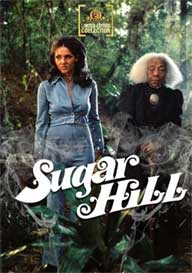
You can purchase the film through the Warner Achieves website as a DVD-R, and the picture and sound quality is quite good.  Don’t expect any extra features, as this is standard for DVD on demand releases.  Still, I was disappointed with the cover art.  Rather than the awesome movie poster (see the top of this post), we’re given a rather bland picture of Sugar and Mama Maitresse, with no trace of zombies at all.  It makes the film look more like a drama than a horror film, which is a mistake when trying to generate interest in a film that lacks a large fan base.  I assume this eliminated the need to pay royalties to the poster artist, but that’s a shame, as a simple change in the cover art would draw viewers unfamiliar with this film.


Yea, that's the DVD-R cover.  Don't judge the movie by it.

Regardless of the cover art, you should check out Sugar Hill.  The film holds up because, at its core, it’s a simple revenge flick.  Racial context aside, any modern viewer will understand Sugar’s motivation and have no problem cheering for her vengeful murder spree.  Toss in some creepy looking zombies and a maniacal Lord of the Dead, and it’s a film every horror fan will enjoy.